|
|
|
Commercial and Industrial Inspections
|
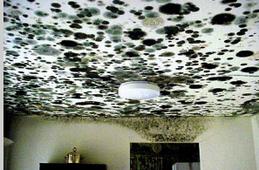
WHAT IS MOLD? Molds are microscopic organisms found virtually everywhere, indoors and outdoors. Mold spores are tiny, lightweight, and easily detached by airflow, vacuuming, walking on a carpet or sitting on a couch. In indoor environments, they grow in air-conditioning ducts, carpets, pots of household plants, etc. They produce and release millions of spores, which are small enough to stay airborne threatening to invade the human respiratory system. Mold growths can often be seen in the form of discoloration, ranging from white to orange and from green to brown and black. In large quantities, molds can cause allergic symptoms similar to those caused by plant pollen. In order for mold to grow, it needs food sources (such as leaves, wood, paper, or dirt), a source of moisture, and a place to grow. UNDERSTANDING TYPES OF MOLD Allergenic molds are normally not dangerous
in low amounts, but they can cause allergenic or asthmatic symptoms
such as wheezing or runny nose. These molds can be abated safely with
the assistance of gloves and a disposable particulate-removing respirator.
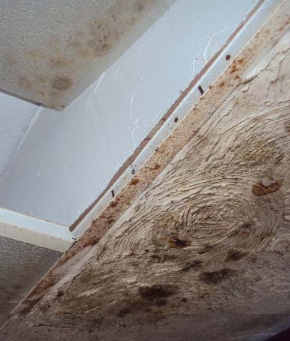
HOW DO YOU COME INTO CONTACT WITH MOLD? Mold spores are found in all homes and offices, and grow rapidly from excess Humidity. The following are some sources of indoor moisture that may cause mold problems in a home or office: flooding, leaky roofs, humidifiers, damp basements or crawl spaces, constant plumbing leaks, house plants, steam from cooking, shower/bath steam and leaks, wet cloths, bathroom towels, pets, sweaty sneakers indoors, dirty HVAC systems, spilled liquids on carpeted surfaces and clothes dryers vented indoors. WHAT CAN MOLD DO TO YOU? Exposure to mold is not healthy for anyone but the following individuals are at a higher risk for adverse health effects: infants, children, elderly, immune compromised patients, pregnant women, and individuals with existing respiratory conditions. When inhaled, even in small amounts, mold can cause a wide range of health problems including respiratory problems (wheezing), nasal and sinus congestion, watery and red eyes, nose and throat irration, aches and pains, fevers, and in some cases even death. CAUSES OF INDOOR MOLD GROWTH High moisture is the major contributor to indoor microbiological activity (mold growth). This is due to nutrients for spore germination and growth being readily available in most household constituents. These household constituents can be dirt, dust, wood, paper, adhesives, acoustical fiber, paint textiles, stored material, carpets, floors, and much more. The actual germination of fungal spores and mold growth is influenced by several factors. These factors ar as follows: Time Reaming Wet Water Source Contamination: Substrate: Light: Temperature: Air Velocity: Nutrients: Humidity: Moisture: WARNING SIGNS OF POSSIBLE MOLD GROWTH Tree Roots have been known to infiltrate into storm and sanitary lines. When these conditions arise, sewer back up and basement wall moisture are usually the outcome. Tree roots also have a tendency to damage pavments and foundations, which could lead to moisture in basements. We strongly urge you to question the past owner if the past seepage or sewer backup has existed, if it has, future maintenance will be probable, and biohazards may exist. Moss, mold or mildew on the foundation or on the foundation grading is an indication of poor grading, shading, overflowing gutters, runoff, or other conditions that allows this area to be wet, moist, or humid. Roofs are hazardous and dangerous to physically walk on. Your inspection should be only based on what is visible from the ground level with or without binoculars. A roof may show evidence of past pr present leaks or may soon develop leaks that can cause mold growth. The condition of a flat, metal, or built up roof often cannot be determined unless it is possible for you to closely inspect its surface. Poor roof venting and sometimes tree shading can decrease the overall life expectancy of the roofing system and cause mold growth. Shingles that are uplifting or have popping nails are indicators of potentially undesirable attic moisture conditions. Shingles that are clawing or fish mouthing are indicators of poor attic ventilation. Efflorescence (white powdery substance) and staining of the chimney is an indication of moisture penetrating the system. Chimney Flashing, roof penetrations, other flashing, changes in roof elevation, all have the potential of future maintenance when downspouts and gutters are not properly maintained on garages and dwellings, poor drainage can cause seeping into the dwelling. All gutters and downspouts should be free of debris and properly installed. Many time, past property owners disconnected downspouts at the base and install splash type blocks. These types of repairs may be indicators of past seepage, which the present owner should disclose. Penetrations at vents, Chimneys, and roof flashing should be inspected periodically for deterioration and possible leaks. Overflowing gutters, downspouts, and leaking roofs can cause mold growth. Exterior Wood Surfaces should be treated every 3-5 years. When wood is untreated, it has the potential to develop mold growth that will cause deterioration or possibly enter the dwelling. Untreated wood used for porches, deck columns, and fence posts which are buried in the ground, have a tendency to deteriorate rapidly from mold. Siding should be properly sealed and should have existing weep holes. Foundations that have cracks or problems can cause moisture seepage into dwellings. Drywall nails pops or rusted drywall nails may be the cause of high indoor humidity or possible past/present leaks that may cause mold to grow on exposed or not exposed surfaces. These types of conditions should be controlled. Many times homeowners patch and paint past ceiling or wall leaks. At these locations, we cannot tell if future seepage is expected, unless, it is actually wet or leaking at the time of inspection. Mold is often in walls behind drywall or behind wallpaper. Cleaning carpets often cause high humidity in homes leading to mold growth under the carpet. Attic Temperature that is greater then 30 degrees from exterior ambient temperature should have venting or an attic fan installed. When mold/mildew or dark staining is seen in accessible locations, on or in the sheathing, deterioration may exist. These conditions may be the cause of: condensation during winter months, ice dams, poorly vented bathrooms or kitchen vents, poor attic venting, insulation choking air flow, roof or penetration seepage, and repairs are advised. Most attics are only partially inspected due to constraints such as height, tight, claustrophobic conditions, missing flooring, area cluttered, covered, and difficult entry. At the time of inspection, you only inspect a small sample of structural members and a small sample of sheathing. Attic moisture stains should be monitored for future activity and repaired if active, so further damage or mold growth will not occur. Moisture stains may appear to be dry at the time of inspection, due to; dry weather conditions, hot summer heat, and winter months. Disclosures: Ask if any past seepage of flooding existed from: sewers, storms, and run-off. Basements and crawl spaces have a high probability of containing humid conditions that are desirable for mold growth. Wood products, cellulose products, boxes, paneling, and drywall are not recommended in basements that do not have controlled moisture and humidity. Generally, if you see black mold on the bottom of cardboard boxes you may have a serious mold condition. A high probability exists that mold may be behind drywall or wood paneling if a basement is not 100% dry. Any wood paneling, drywall, or ceiling tiles that are contact with water, high moisture, flooding, or seepage should be removed within 24 hours after getting wet. Furthermore, we recommend you remove at least an additional 12 inches of material past and away from the moisture stains or water-damaged area. Humidifiers on furnaces if not properly
used will cause condensation on sheathing in the attic. The condensation
will result in a black mold appearance. Mold growth on attic sheathing
is not desirable and not healthy if mold spores from the attic enter
the dwelling. We recommend to seal off attics with these conditions
and call professionals to help in the remediation or interim control
progress. Leaking basements and leaking crawl spaces can also cause
this black mold in attic sheathing, other high humidity causing variables
that exist in the dwelling. Humidifiers, furthermore, are known to contain
microbiological growth within their operating housing. We recommend these
areas be properly cleaned periodically. Ductwork in dwelling has a high
probability to contain dust, debris and possible microbiological growth.
We recommend to have all ductwork professionally cleaned. Many older
homes have return air ducts not connected to heating systems, return
air generally must come from the crawl space or basement. Generally,
basement or crawl locations can be wet, moist, musty, moldy, etc. We
recommend to connect the cold air returns to the furnace. The furnace
filters need to be cleaned or replaced periodically according to the
manufacturer specifications. We recommend to install HEPA or high-density
filters to help in the control of filtering out microbiological airborne
particles, dust, etc.
The presence of mold, water damage, or musty odors should be addressed immediately. In all instances, any source(s) of water must be stopped and the extent of water damage determined. Water damaged materials should be dried and repaired. The purpose of this section is to provide home inspectors with a background to recognize problems in a home that can lead to the growth of mold. Mold is a structural and environmental problem. Some mold defects can't be seen and will only be detected through sampling. 1. ENVIRONMENTAL ASSESSMENT A. Visual Inspection A visual inspection is the most important initial step in identifying a possible mold contamination problem. The site should be visually assessed for water damage or mold growth. This assessment is essential in determining remedial strategies. Ventilation systems should also be visually checked for dampness in the system, damp filters, and cleaners. Pay particular attention to cellulose materials, such as, cardboard, paper, ceiling tiles, and sheet rock. The use of equipment, such as a boroscope (to view inner wall space and ductwork) or moisture meter (to detect hidden moisture in building materials) may be helpful in identifying hidden sources of fungal growth and the extent of water damage. Observable conditions that may indicate mold growth include: • Cracks in
shower tile, lack of caulking, loose toilet seal, leaks under sink After the inspection is complete, document all evidence of water penetration as well as conditions that could allow water penetration. It may be necessary to conduct sampling to determine if a mold problem exists and to what extent. 2. SAMPLING INSPECTION Depending on your initial observations, it may be wise to conduct environmental sampling in the site. Use the guidance below to determine when sampling is necessary and what type of sampling to do. A. Scenario 1- When your initial inspection reveals visible
mold. B. Scenario 2- When your initial inspection does reveal
visible mold, but additional evidence indicates conditions that make
mold presence likely. This also applies if the home/office has a moldy
odor but no mold is seen. C. Scenario 3- When the initial inspection does not reveal
mold, and you see no conditions that would make mold inhabitance likely.
|